Last weekend my group chat alerted me within minutes, “Boom! First sub 2 hour marathon!”
At the London Marathon on Sunday, Sabastian Sawe of Kenya officially broke the elusive 2 hour marathon world record for the first time, running an impressive 1:59:30.
This was the ‘felling of the four minute mile’ of my lifetime.
Since I ran my first marathon in 2007, I’ve watched the world record get cut a number of times. The world record back then was 2:04:55 by Paul Tergat. I can’t even picture him now, but I remember his time felt untouchable. Me and my running buddies felt accomplished to run at 4 minute km pace for even a short distance. For that marathon time we’d need to run each and every 42.2 of those kilometres at two seconds under 3 minute pace!
It is a massive achievement for a serious runner to aspire to even go sub 3 hours for a marathon. Most won’t get there. A theory is that even with the correct training, preparation and race, only 10% can physically get there.
By the end of 2007, the diminutive Haile Gebrselassie from Ethiopia had taken the world record to 2:04:26. Both these records were at the Berlin Marathon. He raced again the following year, where he got another world record and the first to go under 2:04. Each breakthrough felt impossible until the moment it wasn’t.
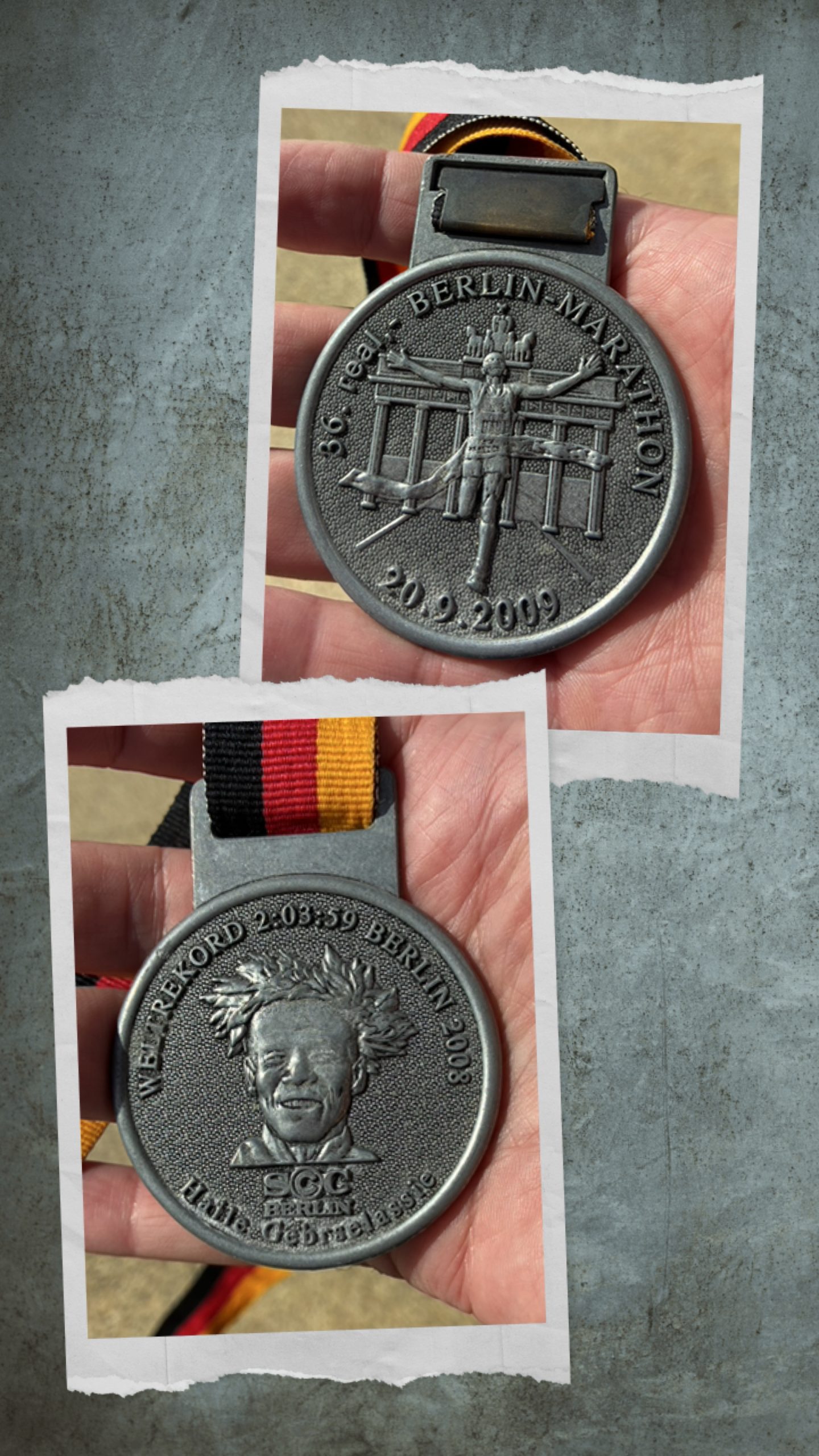
I ran Berlin Marathon myself in 2009, the year after Haile had broken the record yet again. (His feat was recognised with his depiction on that year’s finisher’s medal.)
I remember at the start of 2009 before moving to Dubai, that their own marathon was trying hard to get in on the act and chase the prestige and publicity of snatching the world record. Offering a $1 million bonus, on top of the $250k first prize, was quite the incentive! Haile was in great condition, and there were large expectations with pacers, but the weather didn’t suit. And no, this Middle East race wasn’t too hot. Despite being faster through halfway than his Berlin time, and still on track at 30km, his chances were stifled from it raining most of the race, and finishing in torrential conditions.
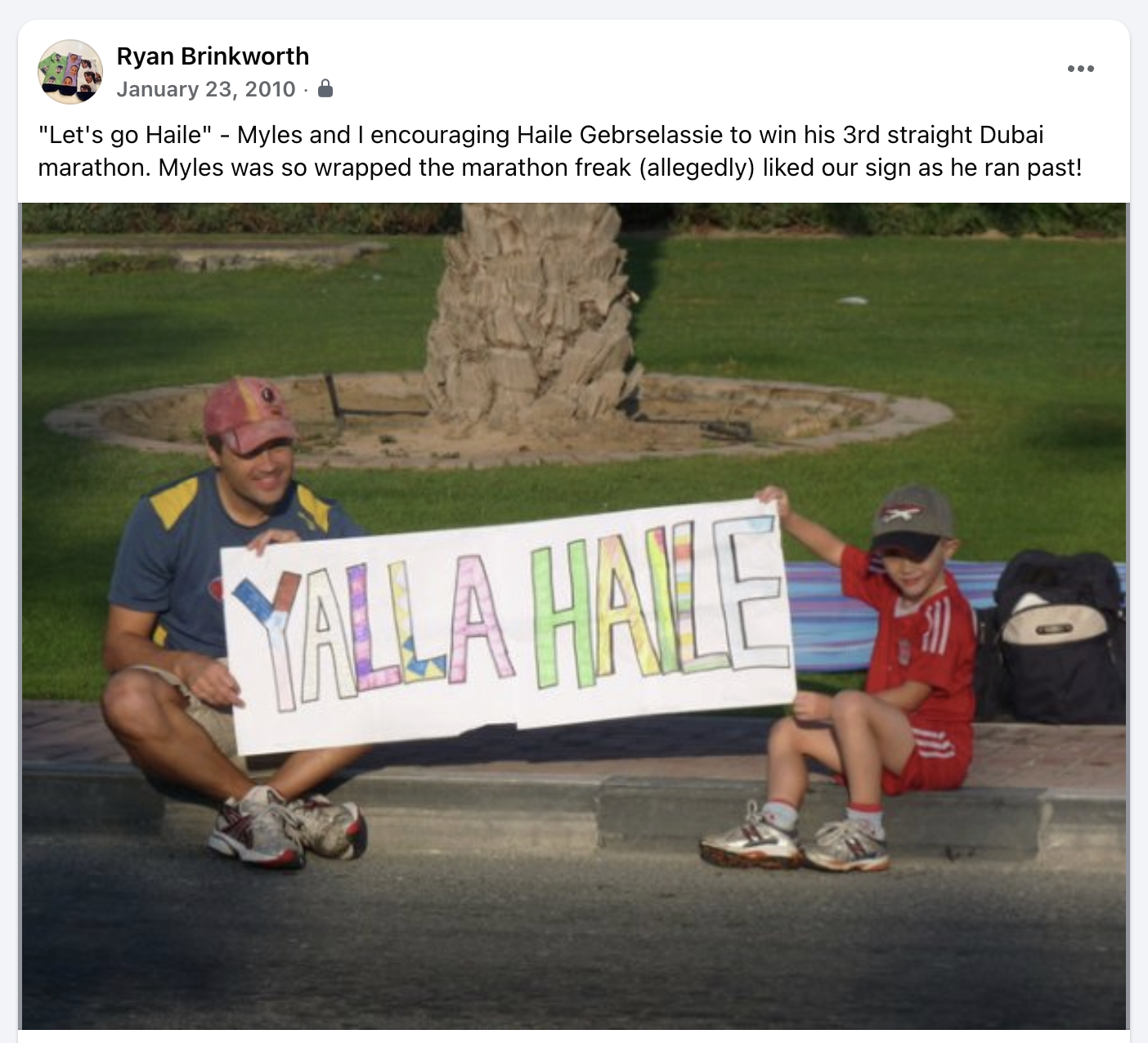
The next year with my family there, Myles & I went down to watch the Dubai marathon and cheer on Haile. Our cheering & signs didn’t get him the record that year either, it only helped him get his third Dubai victory in a row. Sadly, it was his final marathon success.
The Ethiopean’s retirement was the end of an era, but the marathon record was not done there. In 2011, another 21 seconds was shaved off by Kamau from Kenya, then another couple of years later, another Kenyan, Kipsang shaved off a further 15 seconds. In fact, the world mark was bettered by five Kenyans until Sawe’s sub 2 hour record this year (incidentally four of those five Kenyans had surnames beginning with “K”).
The most recent K, alliteratively two Ks at that, Kelvin Kiptum is sadly one of the most tragic athletic stories. He won his first three marathons super impressively, each in under 2:02. The third win was the 2023 Chicago Marathon where he set the new world record at 2:00:35. And Kelvin finished looking so fresh, while sprinting to the line with such strength, that it didn’t seem to be whether he would break 2 hours, but when. Sadly it wasn’t to be. Four months after that marathon, at the tender age of 24 and such an amazing career ahead of him, he was in a fatal car crash, where he died alongside his coach.
The marathon record Kiptum had broken was that of the G.O.A.T., Eliud Kipchoge. He has possibly the only name in marathon running that people might recognise. Kipchoge won two Olympic golds, and multiple marathon majors over many years. He is also famous for being the first man to run sub 2 in an unofficial exhibition run. It was held on an unfairly speedy course, there were pacers in a helpful formation against the wind, and they had a car beaming a laser beam that showed the required pace. It was still extremely exciting and nerve-wracking to watch, and finished with such a buzz. It was one of the moments where I still know exactly where I was. My family & I were having dinner at the Elephant & Wheelbarrow in Melbourne CBD, as it was the night before I ran the Melbourne Marathon. It didn’t lead me to break any records. It did lead many runners to see a new level of human endeavour.
Australian running legend Steve Moneghetti ran in Berlin in 1990, and he’s put the scale of last Sunday’s achievement better than anyone. “When I won the Berlin Marathon in 2:08:16, I was only a minute and a half off the world record,” he said. “I was the 16th fastest in history. I wouldn’t have been in the top 100 in London.” (Source: CODE Sports, Facebook)
Let that sink in for a moment.
The sub-two-hour marathon was discussed for years in the same breath as the four-minute mile. That particular feat was widely believed to be beyond human capability that doctors had warned attempting it might kill you. It didn’t, Roger Bannister broke that mark at Oxford in May 1954. And fast-forward to today, that same middle distance time isn’t enough to qualify you for the Olympics! The barrier was never physical. It was just a number nobody had reached yet.
It’ll be interesting to see just how far the world record can go under 2 hours. I’m glad I got to see it broken in my lifetime. It makes me wonder what else might be possible.
Although it’s not a topic I know very much about, it would be remiss of me to not mention Ethiopia’s Tigst Assefa also beat the women-only record at the London Marathon. The new time for the lades to beat is 2:15:41. My personal best is over an hour slower!
And spare a thought for Yomif Kejelcha. He is the Ethiopian runner who also went under 2 hours at the same London Marathon, successfully breaking the existing world record also, only to finish in second place. I wonder if he’ll be like the astronaut who had to stay aboard doing calculations while the others stepped down onto the moon’s surface to play a bit of golf. It was Yomif’s first marathon though, he’ll get better. I also know what it’s like to not win a marathon on my first attempt.
ADDENDUM:
There have been several additional insights that have come to light following Sawe’s run which I’ve found fascinating:
- The second half marathon (which for London is usually slower), was run in 59:01. That time is faster than the half marathon record for every country, except for 6!
(Source: Science of Sport Podcast – https://www.instagram.com/reels/DX1-hSyv9pN/) - His 30-40km split was run in an unbelievable 27:36. That was faster than the 10,000m at the 2025 World Championships winner, who finished in 28:55.
(Source: sonsofolympiapod – https://www.instagram.com/p/DYEhcPpIuzA/)